
| End User | Scottish Water Horizons |
|---|---|
| Industry | Water treatment facilities |
| Location | Selkirk, UK |
| Assets on site | Solar PV / Wattstor BESS / Podium EMS |
| Solar power | 1100kW |
| Battery (BESS) | 200kW / 1,600 kWh |
Find out how Scottish Water Horizons deployed our energy storage and smart management system to perform vital peak shaving, reduce daily operational costs and mitigate the rising TNUoS charges, all while overcoming strict grid constraints to maximise their onsite solar generation.
Delivering water and wastewater services makes Scottish Water the single largest user of electricity in Scotland. With a pressing need to manage volatile wholesale energy costs and increasing grid transmission fees, the utility needed a robust way to protect its energy-intensive sites from expensive peak-time electricity rates.
As part of the larger Scottish Water group, Scottish Water Horizons plays a crucial role in helping the utility reach its carbon reduction goals. Over the last decade, it has installed solar PV, wind, biomass boilers, and anaerobic digestion. These technologies help offset energy use and reduce CO2 emissions.
The challenge: mitigating peak energy tariffs while restricted by a 200kW grid limit
The cost of importing power from the grid during peak hours was a significant and growing operational burden for Scottish Water Horizons. And especially with the Transmission Network Use of System (TNUoS) charges heavily impacting large energy users. That meant finding a way to lower the site’s peak demand and optimise its Maximum Import Capacity was a crucial project they wanted to undertake.
To mitigate these costs, their plan was to install onsite solar generation at scale to power the facility directly. However, the local Distribution Network Operator (DNO) severely restricted these plans, limiting onsite generation and export to just 200kW. Scottish Water Horizons needed a solution that could smartly store energy to avoid expensive peak grid tariffs, while simultaneously bypassing the restrictive 200kW grid limit so they could install enough solar to make a real dent in their energy bills.
To do that, they utilised Wattstor (in partnership with Emtec Energy as designer and installer) to benefit from our DC-coupled BESS solution in order to overcome grid constraints and get closer to their renewable generation targets.
Goals:
- Implement automated peak shaving to reduce daily energy costs and mitigate rising TNUoS charges.
- Bypass the restrictive 200kW grid limit to unlock massive onsite solar generation.
- Maximise available land to generate cheaper, behind-the-meter power and reduce grid reliance.
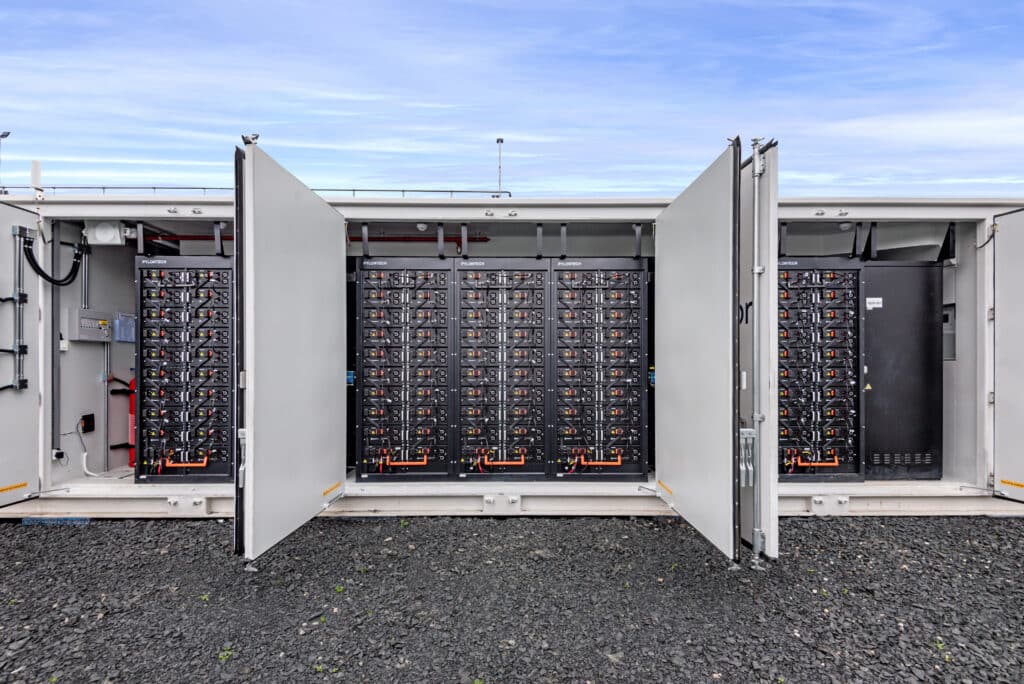
Our approach: automated peak shaving powered by DC-coupled BESS
To deliver maximum financial impact, we created a bespoke project design focused on high-volume onsite generation and intelligent load management.
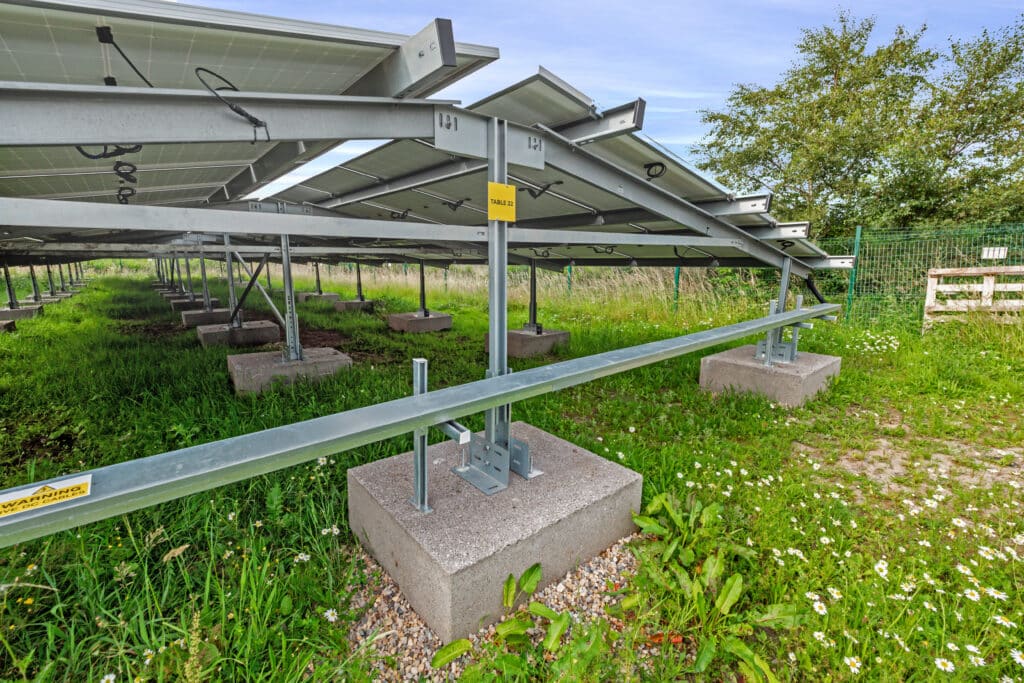
To help Scottish Water Horizons bypass restrictive grid constraints, we deployed Wattstor’s flagship DC-coupled BESS technology. By sending DC electricity directly from the solar panels to the battery system, we enabled the installation of 1.1MW of solar (2,112 panels) while strictly maintaining the site’s 200kW AC grid connection limit. This architecture allowed the site to “oversize” its solar array to ensure ample power was always available for storage and peak shaving.
To transform this hardware into a cost-reducing asset, we integrated Podium, our AI-based energy management system (EMS).
Podium is designed to manage the entire energy ecosystem without human intervention. By analysing real-time electricity market data, TNUoS tariff windows, and site usage patterns, Podium automatically executes peak shaving strategies. It ensures the battery is charged during low-cost periods and discharged when grid prices and transmission charges are at their peak, maximising daily cost savings and ensuring every kWh of onsite solar is used where it delivers the most value.
Finally, to ensure long-term operational resilience, the system was fitted with remote fault detection, automatic shutdown systems, and battery fire suppression.
The Process:
- Bespoke system design to bypass grid constraints and maximise ROI.
- Installation of 1.1MW of solar PV for large-scale behind-the-meter generation.
- Deployment of 200kW/1.6MWh DC-coupled BESS to enable high-volume storage.
- Podium AI integration for automated peak shaving and TNUoS mitigation.
- Safety & Resilience measures – fault detection, shutdown systems, and fire suppression.

Results: Automated peak shaving and 5x more solar
By integrating Wattstor’s DC solution and Podium AI, the system actively protects the facility from volatile energy markets and rising TNUoS charges through automated peak shaving.
Mr Mearns highlighted the importance of the system’s optimisation through Podium AI, thanks to its ability to automatically monitor the wholesale energy market and make smart decisions accordingly:
“As the scheme is remotely monitored, at the time of year when there’s not a lot of sunshine, it allows us to import from the grid at a lower rate to charge the batteries and then feed it back into the works during the times when it costs more, helping to reduce operational costs.”
In addition, using Wattstor’s DC solution, Scottish Water Horizons installed five times more renewable generation assets. This would not have been possible under their normal grid limit. This boosted its generation capacity to 1.2 megawatts, covering over 30% of the site’s power demand. Moreover, with battery storage, it can maximise the use of energy generated onsite.
“Thanks to the inclusion of the batteries, we have been able to maximise the potential of the site to generate renewable energy. The size of the land meant we could install a large number of solar panels. The batteries would then allow us to store and use more of the electricity. rather than having to export it to the grid.”
The project is also massively contributing to Scottish Water’s sustainability agenda by saving 169 tonnes of carbon emissions annually.
Finally, the grid connection opens up the opportunity for future energy trading in the wholesale market. This allows SW to maximise the project’s ROI by exporting excess solar energy at the best possible time to increase revenues.
“We’re proud of Wattstor’s involvement in this project,” commented Wattstor’s CCO Kevin Ball. “The water and wastewater industry is on a tight deadline to reduce its carbon emissions. Regulators as well as the public are closely scrutinising the sector to ensure progress is made. It’s great to be able to offer concrete solutions that help water companies overcome their sustainability challenges.”
Outcome:
- 1.2 megawatts of renewable energy generated
- 169 tonnes of carbon saved annually
- +30% of the site’s power demand is met
- 100% of the renewable energy generated is used
- Possibility to export excess energy to the grid
Maximise your site’s energy potential and automate your peak shaving strategy. Contact Wattstor today to discuss how we can help you mitigate TNUoS charges and reduce operational spend. Our expert team can help! Get in touch today for a free consultation.
1.2 MW
renewable energy generated
169
tonnes of carbon saved annually
Up next...
Boosting Sustainability & Energy Resilience for Exeter City Council
Contact us
If your commercial energy bills are too high but you have plenty of roof space, we could help you cut costs and carbon. Tell us more below
Contact us
If your commercial energy bills are too high but you have plenty of roof space, we could help you cut costs and carbon. Tell us more below
-
 +44 (0) 20 3868 5555
-
[email protected]
-
Wattstor Ltd, 21 Ironmonger Lane, London EC2V 8EY


